This blog draws on findings from: Why direct payments are more effective for combatting poverty than fair prices (2026)
For a long time, voluntary certification of tropical commodities has been used to support farmers and their communities in their efforts to promote the application of sustainable production practices and to enable market exchange under fair trade conditions. Most of these efforts focus on improvements upstream in the supply chain, trying to raise farmers’ incomes and workers’ wages through higher productivity or with better farmgate prices. In practice, however, these arrangements tend to benefit processors and retailers more than farmers.
A growing number of studies show, however, rather mixed and modest effects of certification. This is partly caused by the rising costs for input purchases and credit, but also due to high charges for certification. Since the certified crops only represent a part of farmers’ activities, it proved to be difficult to guarantee living incomes[1]. More importantly, farmers invest considerable efforts to obtain certification, but are only able to sell part of the harvest under preferential conditions, mainly due to worldwide over-certification.[2] While positive effects for strengthening farmer cooperatives are generally confirmed, wider benefits for improved sustainability and women’s empowerment lag behind.
Therefore, many are searching for actionable alternatives or useful complements to enhance the competitive position of smallholder farmers. Most attention is given to strategies that include commitments of downstream supply chain partners and strengthen the bargaining power of farmers with traders, processors and exporters. The growing role of these midstream stakeholders can be evidenced by joint investment in product upgrading through local processing companies or engaging in profit-sharing with large international firms. This blog reviews these experiences and provides some perspectives for further action.
In addition, experiments have started to identify opportunities for improving the payment procedures throughout the supply chain. Instead of just offering higher or more stable farm-gate prices, there is a large potential to simply adjust cash flow (payment) patterns in order to support farmers’ possibilities to take risk and to extend their time horizon for longer-term investments. This new focus relies on practical incentives to modify supply chain interactions and strengthen foresight opportunities for poor farmers, that are critically important to improve household food security expenditures and reinforce the position of women in rural communities at relatively low implementation costs.
Searching for alternatives
Important efforts are made to identify alternative strategies for strengthening the position of smallholders in tropical value chains. Most attention is given to opportunities to improve household incomes through better upfront payment procedures in order to stabilize their daily expenditure pattern. This enables farmers to use more productivity-enhancing inputs (such as better seeds or fertilizers) and to invest in product quality improvements that make them eligible as preferred suppliers for international companies. Such long-term partnership offers protection against unexpected shocks.
In line with earlier experiences with market reforms in the European Union and India, it is more effective to influence rural welfare and farmers’ behaviour through direct income transfers than by using market-based incentives.[3] Therefore, instead of ex-post payments[4] after the delivery of the product, it is preferred to offer regular direct payments to producers during the production cycle that enable them to invest in more sustainable production practices and support their engagement in local processing and income diversification activities.
Such direct payment arrangements focus on stable long-term partnerships between farmers and traders/processors and reinforce mutual reliability, trust and accountability. This is helpful to control sales costs and to reduce market risks, and contributes to stable household expenditures, even when prices remain unchanged. Predictive and more reliable income streams deliver more welfare effects than higher prices at the end of the season.
A theory of change for direct payments
The basic rationale behind direct payments is that the traders and processing companies are willing to pay part of the market value to farmers in small disbursements during the production cycle, even before the product is delivered. This can be easily done as a regular weekly or monthly cash transfer through digital platforms. These advance payments permit farmers to purchase farm inputs, pay hired labour and finance their basic family expenditures during the period that the crop is still on the field. Traders benefit from more reliable procurement and less side sales[5]. The theory of change for direct payments shows that they can be particularly helpful to stabilize food security and are very supportive for strengthening the position of women as key recipients.
Figure 1: Theory of change for direct payments
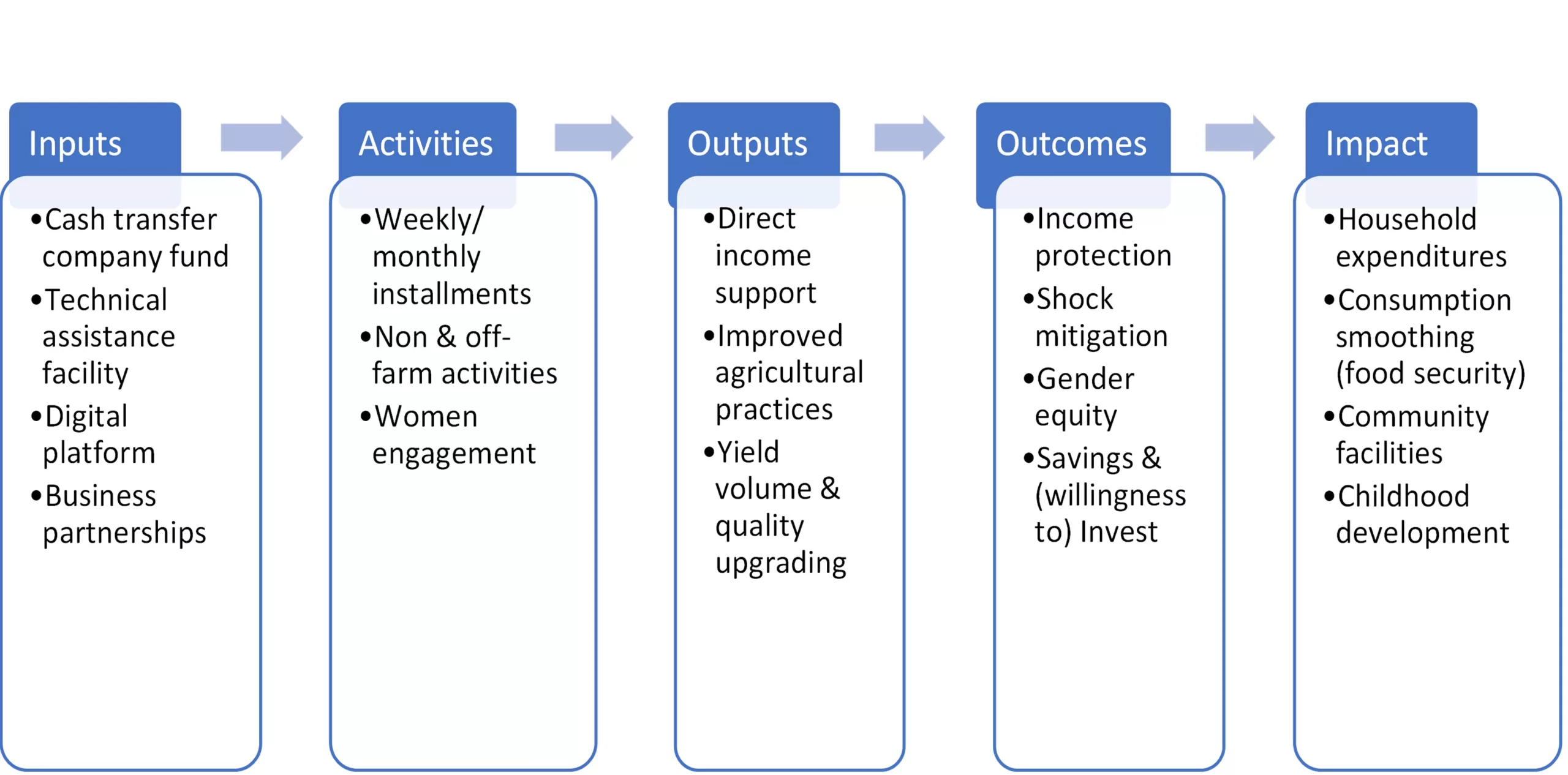
Source: Ruben, R. (2026) ”Why direct payments are more effective for combatting poverty than fair prices”, Sustainable Futures, vol. 11, p.5, Fig.2
Cash transfers are widely used by governments to support poor families facing income shortfalls.[6] Applications funded by private enterprises are gradually starting and can be attractive for strengthening the reliability of supplier commitments (e.g. for reducing side sales) and to support the product quality and transparent sourcing procedures between farmers and traders/processors. In some cases, local community organizations are involved in providing technical and logistic support.
Strong impacts of direct payments
Taking the household instead of the farm as the main entry point marks a fundamental difference of direct payments with fair prices. It enables women to decide primarily about the use of farm income for household expenditures, usually giving priority to food and nutrition, child education, housing and water and sanitation investment. In addition, a more regular flow of income – instead of lump-sum payments after harvest – allows farmers to plan ahead for longer-term investments.
Field experiments with direct payments are ongoing in supply chains of coffee and cocoa. In Uganda, the NGO Give Directly uses unconditional cash transfers of US$1.000 delivered in three (mobile phone) instalments to coffee farmers in eastern Uganda, resulting after 12-15 month in a 40% increase in household consumption and almost doubling of coffee revenues. This impact remains even three years after the initial implementation. In Côte d’Ivoire, Nestle launched a Cocoa Accelerator program with small weekly transfers up to US$580 for 3 years for cocoa farmers, that are used for education, improved cultivation practices and income diversification, generating substantial improvements in yields (+18%) and food security (+12%).
Outlook and future perspectives
Given the limited effects of market-based support for smallholder farmers, there is growing interest in more structural changes in supply chain arrangements for tropical commodities. This may start with the implementation of direct advance payments, but can be further extended towards partial payments of farmers with shares of the processing company, thus enabling them to benefit from profit sharing. In a next stage, co-ownership in downstream processing facilities could offer opportunities for farmers to receive a larger share of total value added.
Shaping such new supply chain relationships can be supported through policy measures towards greater market transparency, and asks for companies that are willing to engage in field experiments with alternative payment regimes. Local traders and processors might be willing to engage to guarantee more reliable procurement and better quality compliance. An alliance between researchers and practitioners can be useful to accompany this transition with participatory approaches for evidence-based interventions.
Footnotes
[1] The net annual income required for a household in a particular place to afford a decent standard of living for all members of that household. Elements of a decent standard of living include: food, water, housing, education, healthcare, transport, clothing, and other essential needs including provision for unexpected events. Visit The Living Income Community of Practice (LICOP) to learn more: https://www.living-income.com/
[2] Over-certification implies that the certified production is larger than the volume that can be sold at the market on preferential conditions.
[3] Market support measures tend to lead to increasing production and may disregard environmental conditions, and eventually depress farm-gate prices and take away incentives for sustainability investments.
[4] Ex-post payments disburse the market value of a commodity after physical delivery to traders (sometimes with some delay in payment, or with a reduction for quality imperfections).
[5] Side sales occur if farmers are inclined to sell their produce – usually at a higher price – to irregular buyers thus neglecting the delivery contract as preferred supplier to certified traders.
[6] Cash transfers provide direct income support to poor families with small regular (bi-)weekly instalments throughout the year. Specific conditions may be attached to the transfers, such as the participation of children in primary education, or the obligatory attendance of pregnant women to primary health care facilities
References
Ruerd Ruben (2026). Why direct payments are more effective for combatting poverty than fair prices, Sustainable Futures, 11: 101575, https://doi.org/10.1016/j.sftr.2025.101575
Ruerd Ruben (2024). From market-based development to value chain transformation: What markets can (not) do for rural poverty alleviation?, Journal of Rural Studies, 109: 103328, https://doi.org/10.1016/j.jrurstud.2024.103328.
Ruerd Ruben (2025). Digging Deeper Into Living Income: Policies and Strategies for Rural Poverty Reduction in Tropical Value Chains. Sustainable Development 33 (6): 8239–8250. https://doi.org/10.1002/sd.70100.
Ruerd Ruben (2023). Why do coffee farmers stay poor?. Journal of Fair Trade. 2023. Vol. 4(2):11-30. DOI: 10.13169/jfairtrade.4.2.0002
Curious about what the evidence says on smallholders’ living income?
Explore the Evidensia Library to find credible studies, or use the Geographic Map to see where credible studies have been conducted and identify regional hotspots, the Knowledge Matrix to gain an overview of research across sectors, issues, outcomes, and approaches and spot evidence gaps, and the Visual Summaries to explore the findings of systematic reviews, where individual results from impact evaluation studies are plotted to show clearly what the evidence says on specific research questions.