Walking around a supermarket, most of us have probably noticed small colourful labels on coffee, chocolate, bananas, cardboard packages, and even cotton t-shirts. Behind these labels are sustainability certification schemes (CSLs), which set environmental, economic, and social requirements for products, many of them from plant-based, or “biobased,” value chains. These schemes are increasingly relevant in the context of the EU’s circular economy and bioeconomy strategies, which aim to reduce reliance on fossil resources, promote renewable biological materials, and ensure that this transition is environmentally and socially sustainable.
While these labels are designed to signal sustainability to consumers, their implications extend far beyond the supermarket shelf. For the farmers, companies, and communities operating along certified biobased value chains, certification can shape production practices, market access, and costs in profound ways. This raises critical questions: does certification genuinely deliver benefits on the ground, or does it only introduce new administrative, financial, and technical burdens?
With the demand for biomass[1] expected to rise in the coming years, and with many EU regulations already relying on CSLs to demonstrate compliance with sustainability goals (e.g., the Renewable Energy Directive), it is essential to examine how CSLs impact the companies expected to use them. If certification fails to work as intended, it risks imposing costs without advancing sustainability goals, weakening both business incentives and policy effectiveness.
What does the evidence say?
To understand how sustainability certification affects companies and farmers, we first turned to scientific literature, and we conducted a systematic literature review covering a wide range of value chains, such as palm oil, wood, cotton, soy, and more. The work was carried out as part of HARMONITOR[2] and 3CO[3].
Our guiding question was:
What are the socio-economic impacts of certification on companies along biobased supply chains?
The analysis of the 75 qualifying scientific articles revealed a mixed picture: while most studies show that certification tends to be beneficial for companies along the supply chain, the story is more complex than this. The figure below summarises these findings, showing how many studies report increases (yellow bars), decreases (purple bars), or no effects (blue bars) on key economic and social outcomes following certification. These results are discussed in detail in the following sections.
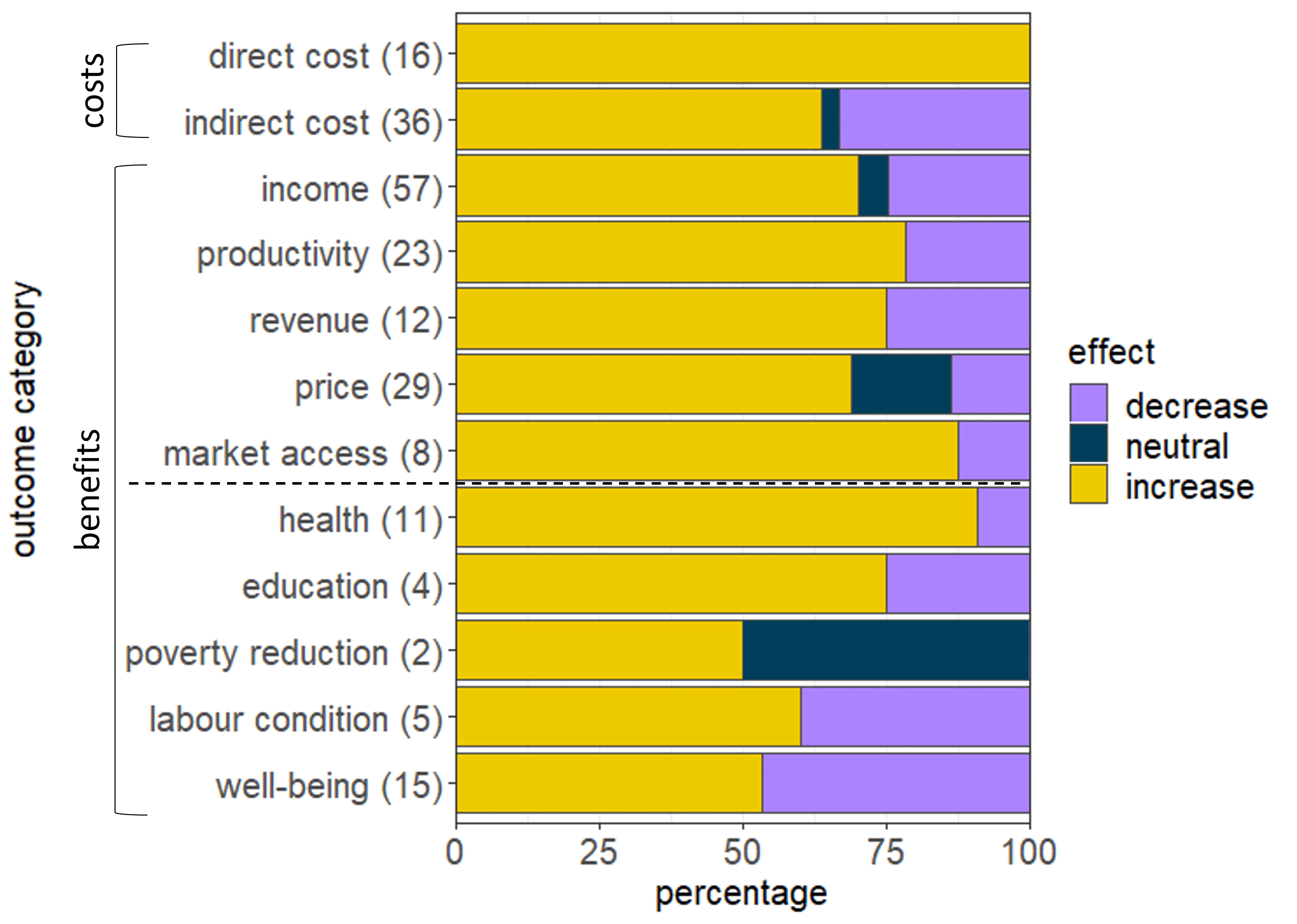
Figure 1. The figure shows the percentage of results (218 in total) extracted from 75 studies indicating that certification causes an increase (yellow), decrease (purple) or makes no difference (dark blue) on different economic and social aspects. Numbers in parentheses represent the total number of results for each outcome category.
Is certification worth the cost?
Overall, the literature suggests that certification can be economically worth it, but only under certain conditions. While certification frequently increases production costs, these costs are often offset by economic benefits for many producers (though not for all, as we´ll see later).
As shown in the figure by the yellow bars, certification commonly leads to higher costs, particularly in the early years. Farmers incur direct costs such as certification and audit fees, as well as indirect costs related to system upgrades, staff training, and compliance with new sustainability requirements. Together, these can raise overall expenses by around 15–20%.
At the same time, certification can generate economic gains. Many producers report higher harvest rates, access to price premiums, improved market access, and stronger relationships with buyers. For those able to capture these benefits, certification results in a net positive economic outcome. However, these benefits are unevenly distributed, and not all producers are able to recover their additional costs.
Who really benefits – and who struggles?
In most cases (around 60 % of the studies we examined), certification is economically worthwhile. However, the picture is more challenging for smallholders and producers in low-income countries, as they tend to face more challenges compared to other companies. High upfront costs for certification and audits, limited resources, and a lack of technical expertise or reliable information can make participation difficult. Even when certified, these producers may struggle to access premium markets or negotiate better prices.
Producers outside the EU may also struggle to meet requirements developed in a European context. For instance, sustainability standards designed for temperate forests (typical in Europe, North America, and East Asia) may not be easily applicable to tropical forest systems, which are more complex to manage. Moreover, upstream actors, such as farmers and primary producers, usually bear higher costs and receive fewer benefits than downstream actors like processors, traders, and retailers. As a result, while certification tends to be economically viable overall, it can also exacerbate inequalities within supply chains and regions, rewarding larger producers in high-income regions. This dynamic risks excluding smallholders and producers in low-income regions, who may instead redirect uncertified products to markets with less stringent requirements, potentially reinforcing less sustainable production practices compared to what could be achieved under more inclusive certification systems.
What about the social impacts?
Studies examining the social impacts of certification present a mixed picture. In particular, certification was found to enhance access to healthcare in (almost 90% of studies that examined this outcome) and education (around 75% of studies), often through training opportunities or community infrastructure projects funded by certification programs. However, its influence on labour conditions, poverty reduction, and overall well-being is far less consistent. As we can see in Figure 1 above, some studies even report negative outcomes, such as increased land conflicts when tenure rights are unclear, or the exclusion of women from participation due to limited access to resources and decision-making power.
Understanding this mixed evidence is complicated by the fact that, while economic impacts have been more widely examined, social impacts remain under-researched. One reason for this is that social outcomes are inherently more difficult to measure than economic or environmental ones. They often rely on subjective perceptions and vary greatly depending on the indicators used. For example, some studies assess health through nutrition levels, while others focus on access to healthcare facilities; education may be measured by years of schooling in one study and by the number of schools in another. Such variation makes it challenging to compare results and draw general conclusions.
Another contributing factor might be that CSLs themselves tend to prioritise economic and environmental criteria, giving less attention to social dimensions. This imbalance might often reflect the priorities of industry stakeholders, who, according to literature, are typically more concerned with market access, competitiveness, and price premiums than with labour rights or community well-being (Brandi et al., 2015, Ogahara et al., 2022, Zubizarreta et al., 2021).
So, what can we do?
Certification can support sustainability improvements, but its benefits and burdens are not equally shared across value chains and regions. Making certification more effective and equitable requires collective action from policymakers, industry, and civil society.
Five priorities stand out:
- Governments, development agencies, and downstream companies should support smallholders: provide financial and technical assistance through public funding, donor programmes, or partnerships with buyers to help smallholders comply with certification requirements and access sustainable markets.
- CSLs owners should adapt certification systems: make certification more inclusive and context-specific by involving smallholders and local actors in standard revisions and aligning requirements with local socio-economic and environmental realities.
- EU and national policymakers should focus on holistic policies: place equal emphasis on social objectives, including fair labour conditions, land rights, and community well-being.
- Public authorities, other funders and research institutions should invest in standardized research: generate context-specific evidence on certification impacts and develop standardised, measurable indicators to support more equitable and evidence-based policy and standard design.
- Retailers, brands, and consumer rights groups should empower consumers: support credible and inclusive certification schemes through informed sourcing and purchasing decisions guided by scientific evidence.
In biobased value chains, certification will only realise its intended impacts if it actively addresses inclusion and fairness, ensuring that sustainability gains translate into real benefits for farmers, workers, and communities. Evidence-based tools, such as systematic reviews and platforms like Evidensia, can help policymakers, companies, and consumers make better-informed decisions about when and how certification works.
Footnotes:
[1] Plant-based materials used for energy, chemicals, and other products.
[2] The HARMOINTOR project, funded by the EU, aims to improve the effectiveness of certification schemes and labels in different sectors of the EU Bioeconomy. Effective and robust certification schemes and labels can set higher levels for sustainability standards within and beyond EU borders. HARMONITOR’s goal is to promote and contribute to better quality and more trustable certification schemes and labels available in the market.
[3] The key objective of the EU-funded project 3-CO is to support sustainable consumption and improve consumer behaviour through smart digital solutions and guidelines for Labelling and Certification Scheme holders. 3-CO will therefore develop and demonstrate the viability of a supportive framework for LCS on Business-to-Consumers communication for industrial bio-based products, and will publish guidelines for label development.
Curious about what other evidence exists? Explore Evidensia’s Geographic Map to see where credible studies have been conducted and identify regional hotspots, the Knowledge Matrix to gain an overview of research across sectors, issues, outcomes, and approaches and spot evidence gaps, and the Visual Summaries to explore the findings of systematic reviews, where individual results from impact evaluation studies are plotted to show clearly what the evidence says on specific research questions.