Voluntary sustainability standards (VSS) have become a central tool in efforts to make global agricultural supply chains more sustainable. Certification schemes, such as Fairtrade International, Rainforest Alliance, GlobalG.A.P., and UTZ[1] aim to promote environmentally responsible production while improving the livelihoods of farmers who produce many of the world’s key agricultural commodities.
These initiatives are now widely used in agricultural value chains, including cocoa, coffee, bananas, and palm oil, among others. Yet an important question remains: do sustainability standards actually improve the livelihoods of smallholder farmers?
We examined this question through a systematic review of the literature from Ghana and Vietnam, two countries where smallholder agriculture plays a crucial role in national economies and where production is largely focused on commodity exports (D’Annolfo and De Maria, 2026). Our analysis covered 26 empirical studies from the Evidensia Library examining certified value chains, including banana, cocoa, coffee, mango, palm oil, pineapple, rice, and tea.
Looking at livelihoods beyond income
Income is often used as the main indicator to assess whether sustainability standards benefit farmers. However, focusing on income alone can be misleading. Farmers may experience higher earnings while also facing increased production costs and greater labour requirements. For this reason, it is important to adopt a broader perspective on livelihoods, capturing not only economic outcomes but also social and environmental dimensions.
To assess the effects of sustainability standards, we analysed the evidence using the Sustainable Livelihood Framework (DFID, 1999), a widely used approach that evaluates how development interventions affect different dimensions of farmers’ livelihoods across five types of capital[2].
What the evidence shows
Overall, the available evidence suggests that sustainability standards can contribute positively to smallholder livelihoods.
Across the studies analysed, we identified 128 positive outcomes associated with VSS adoption, compared to 57 neutral outcomes and 23 negative outcomes across the different livelihood indicators considered (Figure 1). While this indicates an overall positive trend, these results should be interpreted with caution: positive effects are not always transformative.
Improvements were most consistent in income, yields, and capacity building, often driven by better access to training and stronger market integration. Neutral and negative outcomes were more common around production costs and environmental indicators, where financial and technical constraints limited uptake of sustainable practices.
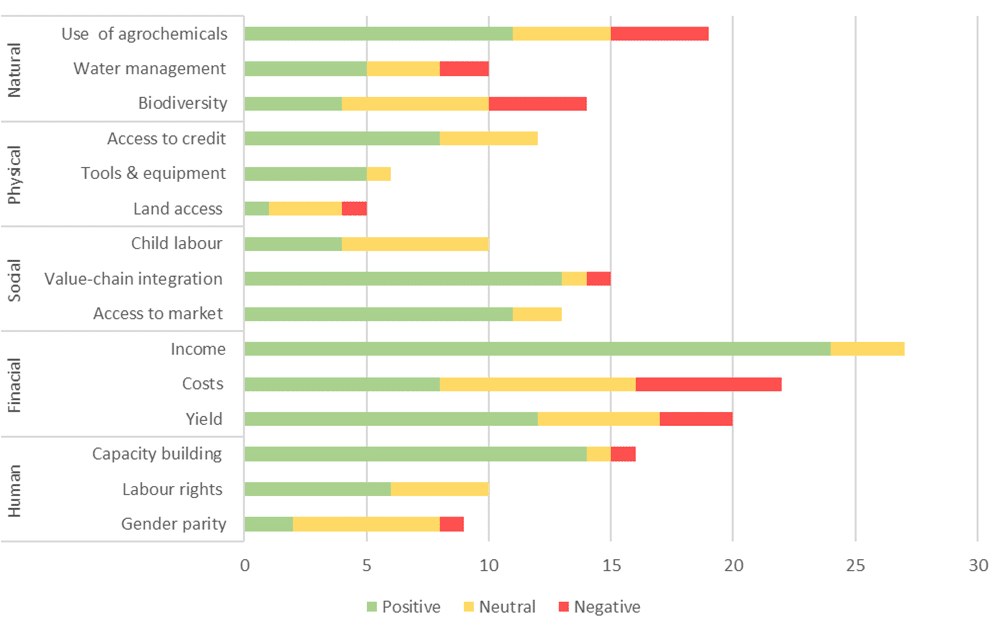
Figure 1. Effects of sustainability standards on livelihood indicators in Ghana and Vietnam (traffic-light visualization).
Key findings at a glance:
- Income & yields: Certified farmers, particularly in cocoa in Ghana, achieved higher productivity and price premiums through improved market linkages and compliance with buyer requirements
- Training & capacity building: Certification programmes consistently improved farming practices, from input management to record-keeping, contributing to higher efficiency and, in some cases, better working conditions
- Market integration: Through cooperatives and producer groups, farmers gained stronger bargaining power and more direct access to export markets
- Child labour: Certification schemes introduced monitoring and awareness programmes, but results were mixed – persistent household economic pressures meant limited change in many cases
Differences between Ghana and Vietnam
The impacts of sustainability standards also varied between the two countries analysed: Ghana and Vietnam (Figure 2).
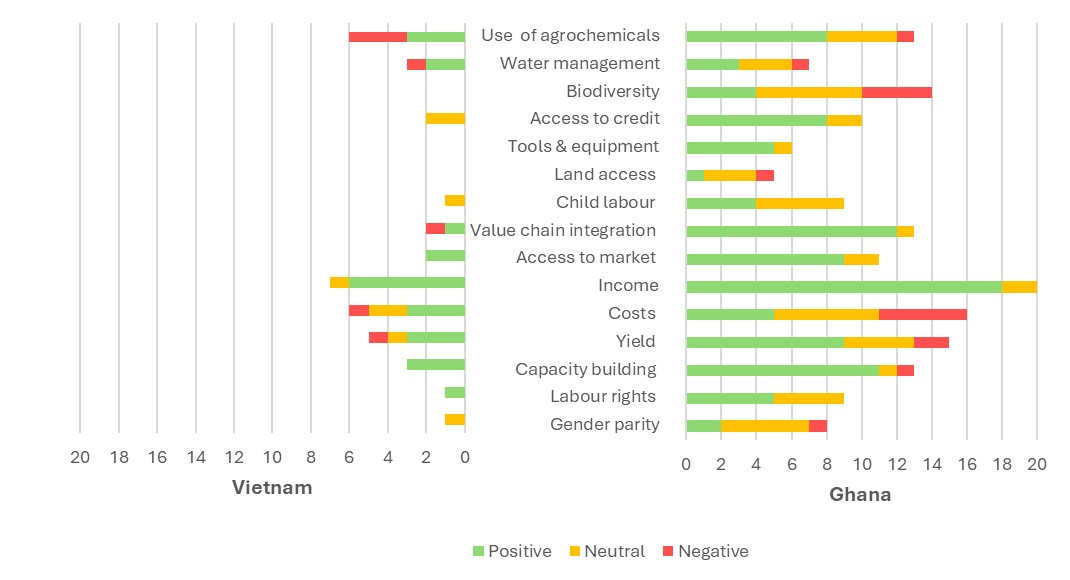
Figure 2: Comparative effects of sustainability standards on livelihood indicators in Ghana and Vietnam (traffic-light visualisation).
Overall, the evidence suggests that positive outcomes were more pronounced in Ghana, particularly in export-oriented value chains, such as cocoa. In these sectors, certification often improved farmers’ incomes, productivity, and access to international markets (Brako et al., 2021). Several studies showed that certified cocoa farmers achieved higher yields and income levels compared to non-certified farmers, partly due to the combination of price premiums, training programmes, and stronger linkages with multinational buyers operating in global value chains.
In Vietnam, the impacts of certification appeared more mixed and less consistent. While farmers often benefited from training programmes and improved production practices, the economic benefits were not always evident. In particular, the reviewed studies showed fewer positive outcomes in terms of income and yields compared with those observed in Ghana, suggesting that the effects of certification in Vietnam were more variable across value chains.
One explanation for these differences relates to structural characteristics of the value chains involved. In Ghana, certification schemes are widely integrated into export-oriented commodity sectors, where international demand for certified products is well established and buyers frequently require compliance with sustainability standards. By contrast, in Vietnam some certified value chains—especially rice—face weaker market incentives. Demand for certified rice remains relatively limited, and dedicated marketing channels are often underdeveloped, reducing the potential price premiums and market advantages associated with certification (Demont and Rutsaert, 2017; Stuart et al., 2018). However, this is not the full picture. Other factors—such as agro-ecological conditions, national policy environments, and the mix of certification schemes—can also shape outcomes, across different contexts.
Overall, these findings highlight that the effectiveness of sustainability standards depends strongly on local institutional conditions, market structures, and supply chain dynamics (Ingram et al., 2018). Certification schemes tend to deliver stronger benefits when they are embedded in well-established export markets with strong buyer demand for certified products, whereas their impacts may be more limited in value chains where market incentives and supporting institutions remain weak – though methodology and timing of studies also shape these comparisons.
Uneven benefits and important trade-offs
The evidence collected also highlights several limitations and trade-offs:
- Production costs: Certification requirements such as inputs, audits, and record-keeping, can increase labour and administrative costs significantly. Cocoa farmers in Ghana reported higher labour costs per hectare, meaning income gains depend heavily on premium size and support received (Ingram et al., 2018).
- Inequality: Farmers with larger landholdings, better education, and stronger resources are better positioned to meet certification standards. This is illustrated in Ghana’s mango sector, where export market access was concentrated among larger, better-equipped producers (Akrong et al., 2022).
- Gender: Women often face barriers accessing land, training, and decision-making roles in certified organisations, limiting their ability to benefit equally (Mauthofer & Santos, 2022).
- Biodiversity: Effects remain mixed – Study on certified oil palm and banana systems found that a focus on high-yield varieties can reduce on-farm biodiversity, and several programmes still lack robust monitoring indicators to assess long-term ecological impacts (Oosterveer et al., 2014).
Taken together, these trade-offs highlight that improvements in one dimension of livelihoods do not necessarily translate into gains across others. Understanding these interconnections is essential to assess how sustainability standards influence smallholder livelihoods in a comprehensive way.
Why context and access matter
In several export-oriented sectors, including cocoa and coffee, certification increasingly functions as a de facto market requirement, driven by international buyers, retailers, and emerging regulatory pressures in importing countries. As a result, farmers may need to adopt certification simply to maintain access to global markets – and those who cannot risk being excluded from these opportunities entirely (Elamin & de Córdoba, 2020).
The evidence also shows that certification rarely works in isolation. Many of the positive outcomes associated with sustainability standards are linked to broader support systems, including national environmental programmes, the availability of extension services, farmer organisations(e.g., cooperatives), NGO initiatives, and partnerships with buyers. In Ghana’s cocoa sector, for instance, strong cooperative and buyer support was key to income and productivity gains. In Vietnam’s rice sector, weaker market linkages limited economic benefits despite improvements in production practices.
In some cases, certification programmes have also generated spillover effects, such as knowledge sharing and improved extension services that benefit farmers beyond those directly participating in certification schemes. For instance, in Ghana’s cocoa sector, training and good practices introduced through certified farmer groups have, in some cases, spread informally to non-certified farmers within the same communities, with similar spillover effects observed in parts of Vietnam’s coffee sector.
Priorities for strengthening impact
Overall, sustainability standards have the potential to improve smallholder livelihoods while promoting market access and sustainable agricultural practices. To maximise their positive impacts, several priorities emerge from the evidence for different stakeholders:
- Governments, NGOs, development agencies and certification bodies should strengthen capacity building and extension services, with long-term investment rather than one-off training.
- Governments, donors, and certification bodies should ensure smaller and more vulnerable farmers can access certification schemes through group certification, credit support, and reduced compliance costs
- Governments, NGOs, companies, and farmer organisations should promote stronger partnerships, particularly in value chains where market incentives remain weak
- Researchers, development agencies, and certification bodies should improve the evidence base through more rigorous and long-term impact evaluations of VSS
Moving forward
VSSs are now a key feature of global agricultural value chains. They provide an important framework for improving environmental practices while supporting smallholder farmers. However, certification alone cannot solve the complex challenges facing farmers in developing countries. In the current landscape of increasing regulatory requirements, attention to supply chain transparency, and climate-related shocks, the role of sustainability standards is becoming even more prominent but also more demanding for producers. Ensuring that sustainability standards deliver meaningful and inclusive benefits will require stronger support systems, better governance, and continued learning about what works—and what does not.
Footnotes
[1] Since 2018, the UTZ certification programme has been part of the Rainforest Alliance (RA).
[2] The five capitals are: human (skills, training, labour rights), financial (income, yields, costs), social (market access, cooperatives, child labour), physical (land, tools, credit), and natural (biodiversity, water, agrochemicals).
References
Akrong, R., Akorsu, A. D., Jha, P., & Agyenim, J. B. (2022). Assessing the trade and welfare effects of certification schemes: the case of GlobalGAP in Ghana’s mango sector. Scientific African, 18. e01425. https://doi.org/10.1016/j.sciaf.2022.e01425
Bissinger, K., Brandi, C., Cabrera de Leicht, S., Fiorini, M., Schleifer, P., Fernandez de Cordova, S., & Ahmed, N. (2020). Linking Voluntary Standards to Sustainable Development Goals. International Trade Centre.
Brako, D. E., Asare, R., & Gasparatos, A. (2021b). Sustainable but hungry? Food security outcomes of certification for cocoa and oil palm smallholders in Ghana. Environmental Research Letters, 16, 055001.
D’Annolfo, R. and Demaria, F. (2026). How do the voluntary sustainability standards contribute to enhancing smallholder farmers’ livelihoods and progress towards SDGs? A systematic review of crop-based food commodities in Ghana and Vietnam. International Journal of Agricultural Sustainability, 24:1, 2616059, DOI: 10.1080/14735903.2026.2616059
Demont, M., & Rutsaert, P. (2017). Restructuring the Vietnamese rice sector: towards increasing sustainability. Sustainability, 9(2), 325. https://doi.org/10.3390/su9020325
DFID. (1999). Sustainable livelihoods guidance sheets, (accessed 1 February 2024). DFID. Retrieved from: https://www.livelihoodscentre.org/documents/114097690/114438878/Sustainable%2Blivelihoods%2Bguidance%2Bsheets.pdf/594e5ea6-99a9-2a4e-f288-cbb4ae4bea8b?t=1569512091877
Elamin, N. E. A., & de Córdoba, S. F. (2020). The trade impact of voluntary sustainability standards: A review of empirical evidence. UNCTAD Researcher Paper No 50, 31 Jul. 2020. United Nations Conference on Trade and Development.
Ingram, V., van Rijn, F., & Waarts, Y. (2018). The impacts of cocoa sustainability initiatives in West Africa. Sustainability, 10(11), 4249–4269. https://doi.org/10.3390/su10114249
Kosolapova, E., Verma, R., Turley, L., & Wilkings, A. (2023). IISD’s State of Sustainability Initiatives Review: Standards and the Sustainable Development Goals: Leveraging sustainability standards for reporting on SDG progress. International Institute for Sustainable Development.
Mauthofer, T., & Santos, M. (2022). 2ndFollow up study: Assessing the impact of Fairtrade on poverty reduction through rural development. Mainlevel Consulting AG.
Oosterveer, P., Adjei, B. E., Vellema, S., & Slingerland, M. (2014). Global sustainability standards and food security: exploring unintended effects of voluntary certification in palm oil. Global Food Security, 3, 220–226. https://doi.org/ 10.1016/j.gfs.2014.09.006
Stuart, A. M., Devkota, K. P., Sato, T., Pame, A. R. P., Balingbing, C., Phung, N. T. M., Kieu, N. T., Hieu, P. T. M., Long, T. H. L., Beebout, S., & Singleton, G. R. (2018). On-farm assessment of different rice crop management practices in the Mekong delta, Vietnam, using sustainability performance indicators. Field Crops Research, 229, 103–114. https://doi.org/ 10.1016/j.fcr.2018.10.001
Curious about what else the evidence says on VSS?
Explore the Evidensia Library to find credible studies, or use the Geographic Map to see where credible studies have been conducted and identify regional hotspots, the Knowledge Matrix to gain an overview of research across sectors, issues, outcomes, and approaches and spot evidence gaps, and the Visual Summaries to explore the findings of systematic reviews, where individual results from impact evaluation studies are plotted to show clearly what the evidence says on specific research questions.