Voluntary Sustainability Standards (VSS) have emerged as a key private instrument to govern environmental and social sustainability challenges in global agri-food trade. Their premise is compelling: (high-income) consumers are willing to pay a price premium for sustainable products, which in turn compensates (poorer) producers for the higher costs of sustainable farming. Ideally, this would create ‘sustainability trading-up’[1]; certified products gain market share, shifting global trade toward more sustainable production and higher prices for producing countries.
Despite their widespread use in public and corporate policies, the impact of VSS on trade remains poorly understood. Most evidence comes from individual case studies, making it difficult to draw broad conclusions. Do VSS lead to sustainability trading‑up, or do they reshape trade in ways we don’t yet fully understand?
Broadening the evidence: 7 commodities and 10 standards
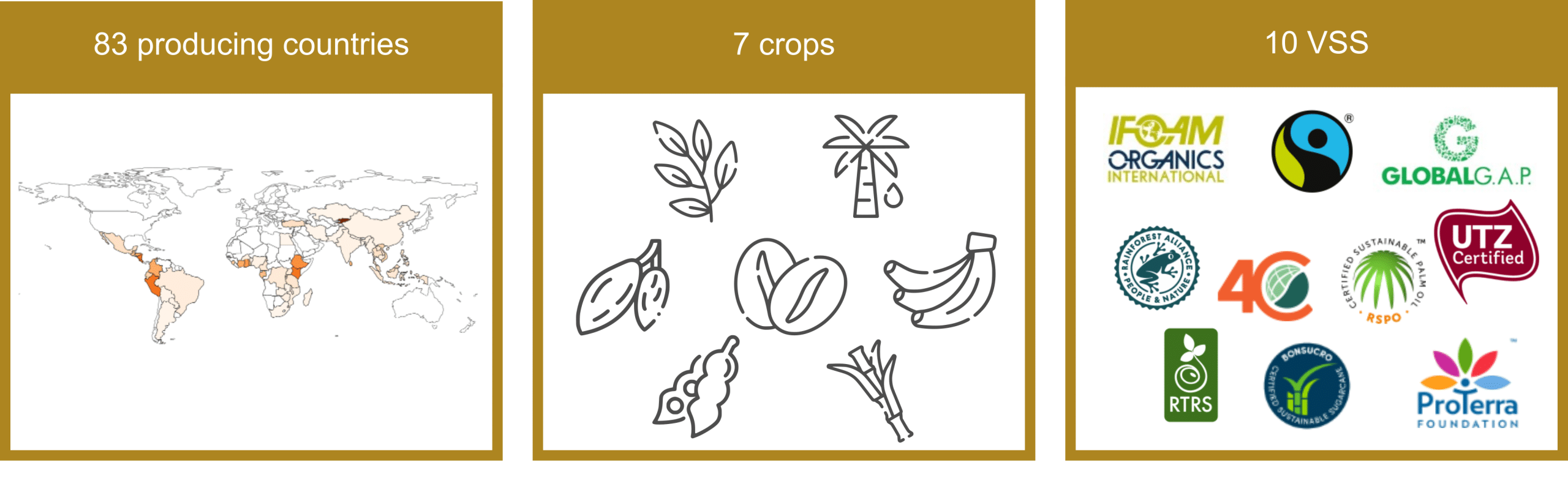
A recent study by Bemelmans, Depoorter, Marx and Maertens (2026), published in Nature Communications, takes a major step toward answering this question. We examine the trade effects of ten prominent VSS in seven major tropical commodities (coffee, tea, cocoa, banana, palm oil, soy, and sugarcane) across two key metrics: export volumes and export prices. The analyses cover bilateral trade flows[2] across 83 producing and 149 importing countries between 2012 and 2020. Uniquely, since not all VSS are born equal, we also study how these trade outcomes are shaped by the design of VSS, understood as the stringency of their producer requirements as well as how compliance with these requirements is enforced.
Two tales of certification: Sustainability trading-up vs price competition
In general, the adoption of VSS in tropical commodity sectors is associated with increased trade volumes but lower export prices. The study estimates that a one-percentage-point increase in certified area generally expands trade volumes by 1.17% to 2.24%, while reducing prices by 0.11% to 0.52%. These estimates represent economically meaningful effects for producing countries that rely heavily on agricultural exports.
This challenges the common assumption that certification leads to price premiums for producing countries. Instead, the study shows that the association between VSS and export prices is more complex. It reveals strong heterogeneity among VSS and commodity sectors. ‘Sustainability trading-up’. is observed for RSPO, IFOAM, and UTZ and in the oil palm and cocoa sectors, and for Fairtrade in the tea, sugarcane, coffee, and cocoa sectors. In contrast, lower export prices combined with increased volumes are observed for GlobalGAP, ProTerra, Rainforest Alliance, 4C, and Bonsucro and in the banana, tea and sugarcane sectors, and for Fairtrade-banana certification. For these VSS and crops, certification facilitates trade through exacerbated price competition. This pattern is driven by differences in VSS design (see below) and sector characteristics and can be explained by efficiency gains, yield improvements, reduced transaction costs or to over-certification and price competition.
Importantly, VSS design matters: only VSS with stringent sustainability requirements and strong enforcement mechanisms generate higher prices and support ‘sustainability trading-up’. In contrast, less stringent standards tend to increase volumes while lowering export prices.
VSS as a bridge across governance gaps
Another important finding concerns “governance distance”, the difference in governance quality between exporting and importing countries. Large governance differences, for instance between high-income countries in Europa and low-income countries in Africa, usually make trade more difficult, for example by increasing transaction costs and reducing trust. The study shows that VSS can help overcome this barrier: certification acts as a private governance mechanism that reassures buyers when public institutions are weaker.
However, there is a trade-off. This bridging effect is strongest for less stringent standards—the same standards that tend to drive price competition rather than price premiums. These easier‑to‑adopt VSS can be valuable for producers in countries with limited institutional capacity, helping them enter global markets. But they are less likely to deliver the higher prices or stronger sustainability outcomes associated with more demanding standards.
Unlocking the full potential of VSS
The study’s message is clear: sustainability standards entail the potential for sustainability trading-up. However, only some standards, and particularly those with more stringent requirements and stronger compliance systems, realize that potential. Others appear to expand trade mainly through lower prices, benefiting consumers more than producers and likely offering fewer sustainability gains.
Yet, these less demanding standards have value too: in countries with weaker institutions, they can play an important role in opening doors to international markets since they significantly increase trade volumes. From a policy perspective, such standards may serve as an important stepping stone: they can help producers gain market access, become familiar with certification procedures, and gradually prepare for compliance with more stringent standards that are more likely to generate higher value. Continued support from donors, companies, and governments to assist farmers and farmer organizations in the certification process can help ensure that these VSS remain accessible, allowing producing countries to access international markets; and capacity-building, technical assistance, and financial support should in turn help them move toward more demanding standards over time.
However, if the goal is to make global trade more sustainable and more equitable for producers, simply increasing the number of certified hectares or farms is not enough. Realizing sustainability trading-up through VSS requires a focus on three priorities: strengthening the requirements of VSS, enforcing compliance with those requirements more rigorously, and stimulating consumer demand for certified products.
Footnotes:
[1] ‘Sustainability trading-up’ refers to a scenario where certification leads to both increased export volumes and higher export prices for producing countries.
[2] Bilateral trade flows refer to the movement of goods between two specific countries – in this case, between a producing country and a first importing country.
Curious about what the evidence says on voluntary sustainability standards?
Explore the Evidensia Library to find credible studies, or use the Geographic Map to see where credible studies have been conducted and identify regional hotspots, the Knowledge Matrix to gain an overview of research across sectors, issues, outcomes, and approaches and spot evidence gaps, and the Visual Summaries to explore the findings of systematic reviews, where individual results from impact evaluation studies are plotted to show clearly what the evidence says on specific research questions.