Voluntary Sustainability Standards (VSS) such as Organic, Fairtrade, and GlobalGAP are often evaluated based on their short-term effects, particularly whether they increase farmers’ incomes or producer prices. But an equally important question receives far less attention: can certification help make farmers’ livelihoods more stable over time?
In a recent study, we examined whether VSS are associated with lower volatility[1] in crop prices, yields, and farm revenues in Peru. The findings suggest that certification can contribute to economic stability, although the effects differ substantially across crops, producer types, and certification schemes.
Why does volatility matter?
Agricultural producers operate in an uncertain environment. Climate change, global market disruptions, and geopolitical instability have intensified fluctuations in both prices and yields in recent decades.
For farmers, volatile prices make it difficult to plan investments, repay loans, or make production decisions. Moreover, yield instability can be equally damaging, reducing farmers’ ability to plan production, manage risks and invest in innovation. Together, these fluctuations can undermine long-term resilience and food security.
This raises a question: can VSS help reduce these risks? Although only a few VSS explicitly target price or yield stability, many may influence volatility indirectly. Certification can affect production practices, market access, buyer relationships, and trade arrangements, all of which may shape how exposed producers are to economic shocks.
Despite this potential, evidence on the relationship between VSS and economic stability remains extremely limited. Previous research has mainly focused on Organic certification in predominantly high-income countries or on specific case studies such as Rainforest Alliance coffee in Colombia.
What did we study?
To address this knowledge gap, we analyzed annual data from a nationally representative sample of around 9,000 farms in Peru between 2015 and 2019. We compared certified and non-certified producers using national agricultural survey data from the Encuesta Nacional Agropecuaria and complemented the analysis with stakeholder interviews with producers, farmer organizations, and audit companies. We examined whether certification was associated with lower volatility in crop prices, crop yields, and net farm revenues.
The study covered both small-scale family farms and large-scale agro-industrial producers. Among family farms, the most common certifications were Fairtrade, Organic, and GlobalGAP, particularly in banana and coffee production. Among agro-industrial producers, GlobalGAP dominated, especially in the avocado and the grape sector.
What did we find?
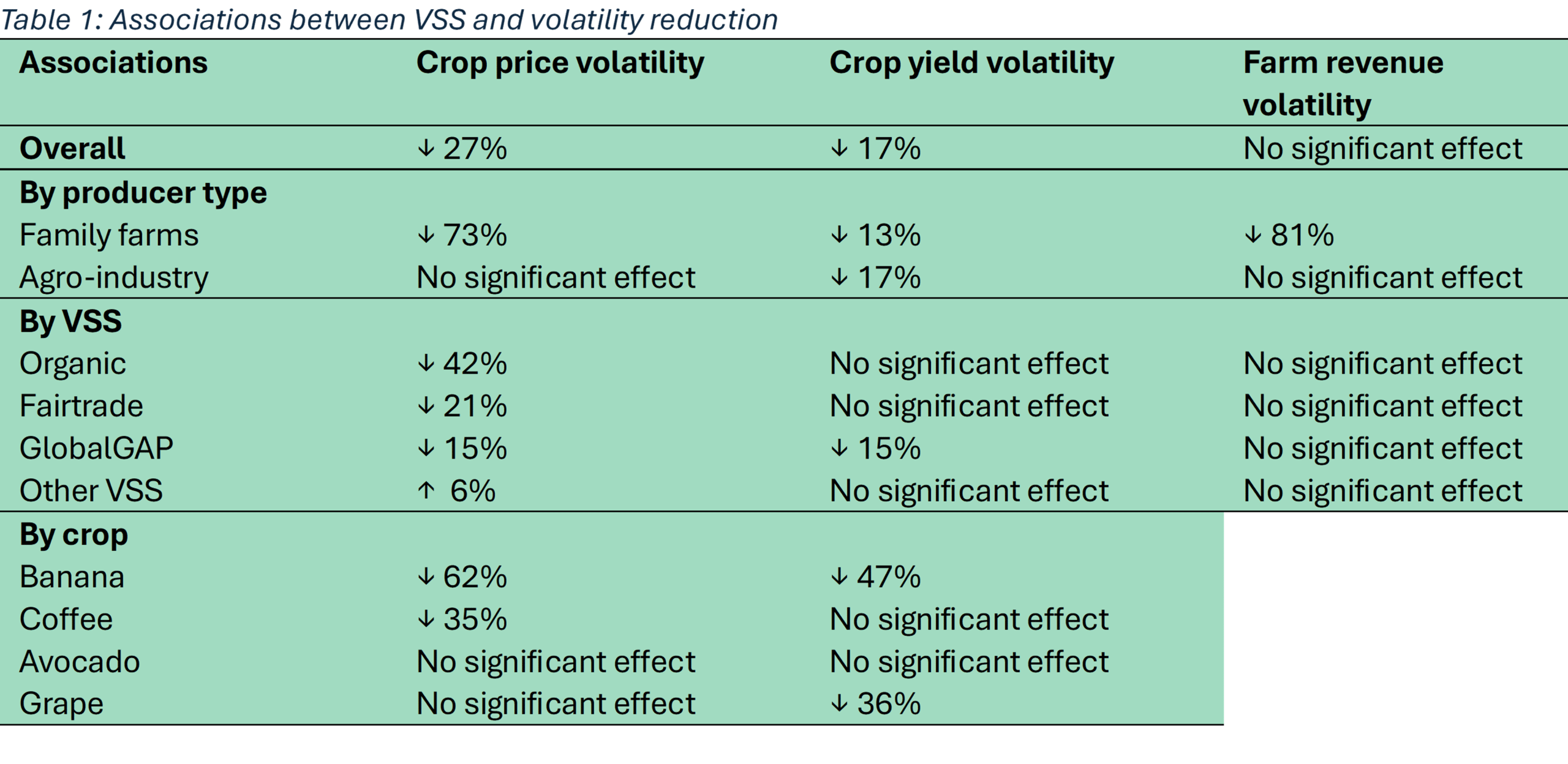
Overall, certification was associated with a 27% reduction in crop price volatility— meaning that price swings were about one-quarter smaller relative to average price levels for certified farms—and a 17% reduction in yield volatility (Table 1). However, these reductions were generally not large enough to significantly reduce overall farm revenue volatility across all producers.
Additionally, the results reveal substantial differences across producer types, certification schemes, and crops. The strongest reductions in price volatility were observed among family farms, where certification was associated with a 73% reduction in price volatility. Family farms also experienced an 81% reduction in farm revenue volatility. This suggests that certification may play an important role in stabilizing farm revenue for smaller producers, who are often more vulnerable to market shocks.
The effects also varied across certification schemes. Organic certification was associated with a 42% reduction in price volatility, Fairtrade was associated with a 21% reduction, and GlobalGAP was associated with both lower price volatility (-15%) and lower yield volatility (-15%). These differences likely reflect variations in VSS design, market structure, and buyer relationships.
The associations also differed strongly across crops. Certified banana producers experienced substantial reductions in both price (-62%) and yield volatility (-47%) compared to non-certified banana producers. Certified coffee producers mainly benefited through lower price volatility (-35%) and certified grape producers experienced lower yield volatility (-36%). For avocado producers, we found no significant association between certification and volatility reduction. These findings highlight that the effectiveness of VSS depends heavily on the characteristics of specific value chains and production systems.
What does this mean for VSS organizations and policymakers?
Our study shows that VSS have the potential to increase economic stability. However, the effects are uneven and context-dependent. Policymakers considering the use of VSS within broader sustainability strategies—such as public procurement, trade policies, or due diligence frameworks—should therefore avoid treating VSS as a one-size-fits-all solution. Instead, expectations should reflect differences across crops, producer groups, and certification schemes.
For VSS organizations, our findings point to two priorities for strengthening their contribution to economic resilience:
- Tailoring of VSS design: We find that VSS are associated with volatility reductions for some producer types, crops, and VSS, but not for all. Designing VSS interventions that better reflect differences in producer capacities, crop-specific risks, and value chain structures could substantially improve their stabilizing effects. For example, this could include incorporating price stabilization tools for highly volatile crops such as avocados and grapes or agronomic support for yield variability of coffee and avocados, as is done by some VSS like Fairtrade.
- Promotion of long-term contracts: During stakeholder interviews, the importance of long-term contracts for stabilizing producer incomes was frequently mentioned. Yet, only Fair Trade USA currently promotes such contracts—and even then, without enforceable compliance mechanisms.
For policymakers, certification should be complemented by broader support measures. Certification uptake remains uneven, particularly among more disadvantaged producers who may face financial or organizational barriers to adoption. Complementary measures, such as extension services[2], inclusive finance, producer support programs, or targeted subsidies, remain essential to ensure that resilience gains are not limited to certified farmers alone. Examples include government-funded agricultural extension, subsidized credit, or certification support programs, such as initiatives that reduce certification costs for smallholders in Kenya’s mango and avocado sectors.
Footnotes:
[1] Volatility refers to the degree of fluctuation in prices or yields over time. In this study, we focus on relative volatility, meaning fluctuations relative to the average price or yield, rather than the absolute size of changes. This allows us to compare stability across farmers with different average production levels or prices.
[2] Advisory and training support provided to farmers to improve their agricultural practices, productivity, and market access.
Study authors:
Eva Boonaert, Postdoctoral researcher at the Division of Agricultural, Food and Resource Economics, KU Leuven.
Eva-Marie Meemken, Professor of agricultural and development economics at the Food System Economics and Policy group, ETH Zurich.
Miet Maertens, Professor of agricultural and development economics at the Division of Agricultural, Food and Resource Economics, KU Leuven.