Sustainability standards have played key roles in promoting sustainable production practices over the past few decades (Marx et al., 2024). Standards pursue multiple paths to achieve sustainability goals. Some standards emphasize outreach to consumer markets to protect global public goods, while others improve the inclusiveness of local producers. In the palm oil sector, this diversity is especially visible because palm oil sits at the intersection of global consumption, environmental concern, and rural livelihoods.
Palm oil has the largest global production volume among vegetable oils, at around 80 million tons, followed by soybean, rapeseed, and sunflower oils. It is widely used for food, consumer goods, and bioenergy. More than 80% of global palm oil production takes place in Indonesia and Malaysia. While the palm oil sector has contributed to poverty alleviation, it has also created sustainability problems including deforestation, loss of biodiversity, and violation of workers’ rights.
Over the last two decades, multiple sustainability standards have actively contributed to sustainable production and consumption in the palm oil industry. Table 1 compares the characteristics of major palm oil standards in Southeast Asia; RSPO (Roundtable on Sustainable Palm Oil) is a non-profit, market-driven certification scheme developed through multi-stakeholder processes in 2007. Meanwhile, ISPO (Indonesian Sustainable Palm Oil) and MSPO (Malaysian Sustainable Palm Oil) are state-driven certification schemes developed in 2011 and 2013. While these schemes are sometimes discussed as alternative frameworks for different sets of requirements, the more important question may be how they serve different market segments and producers, and how they can be combined strategically to expand sustainability outcomes at scale.
This blog is based on the 2023 research paper that examines the impacts of private and public palm oil standards, and policy interaction of the producer countries[1].
Table 1:
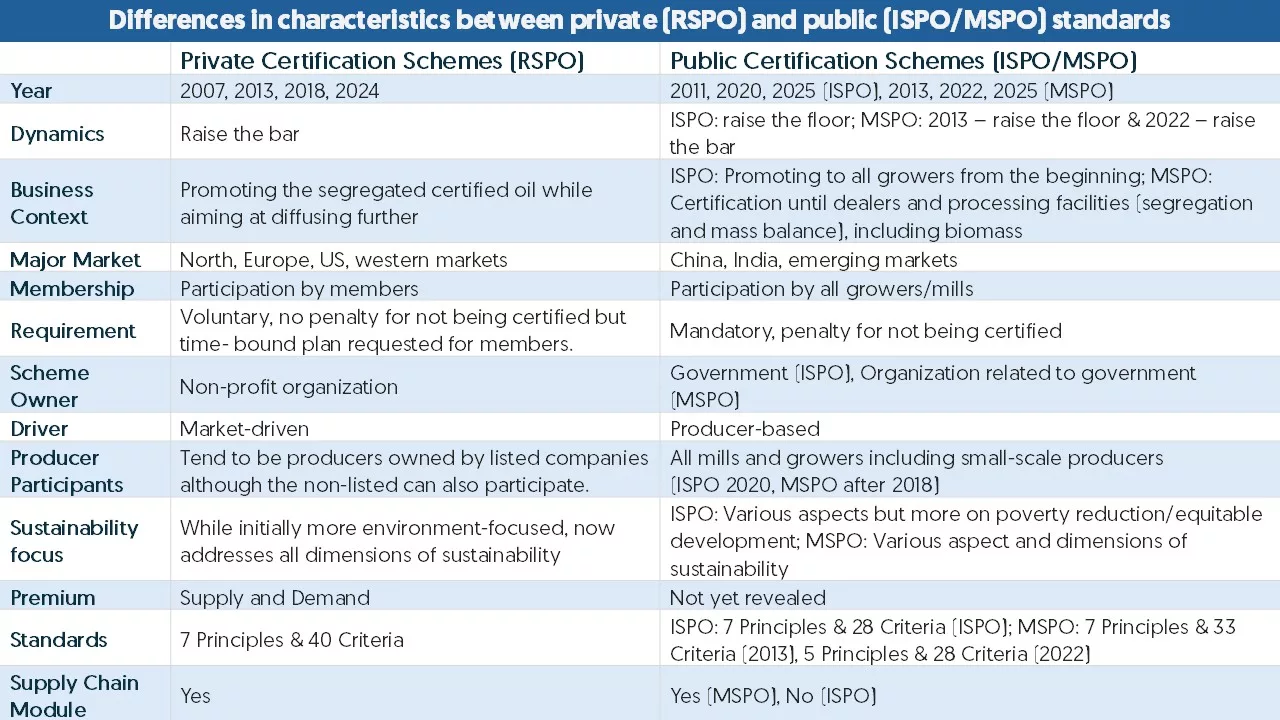
Source: Adapted from Michida, E. (2023). Effectiveness of self-regulating sustainability standards for the palm oil industry. ERIA Discussion Paper Series, No.476, pp. 22-23
Two pathways: private market-driven vs. public state-driven standards
At first glance, the distinction seems straightforward: RSPO is a private initiative shaped by global market dynamics, while ISPO and MSPO are public initiatives embedded in national regulatory and policy frameworks. But the difference is not only about governance design—it is also about who the standards effectively reach.
RSPO has strong links to high-income consumer markets, such as the EU, and to investors placing weight on sustainability, and the analysis shows that the RSPO-certified growers are often associated with the companies listed on stock exchanges (Michida 2023). This is partly because the incentives for RSPO certification are well recognized in the export markets where buyers demand sustainability verification, or when firms face investor expectations to demonstrate sustainability performance. In other words, RSPO certification is not only an environmental tool—it also functions as a mechanism of market access and reputational management.
By contrast, ISPO and MSPO, as mandatory regulations, focus more on smallholders and on market segments that are not necessarily plugged into the global value chains dominated by companies operating in the high-income countries. Such value chains are driven by consumer preferences or capital markets. ISPO- and MSPO-certified palm oil is exported not only to the high-income market but also to emerging markets where a major palm oil market segment exists, but demand for sustainable goods has yet to be established. Therefore, these standards reflect a different pathway: one in which sustainability is built through national systems, capacity-building, and domestic or emerging-market realities.
Figure 1:
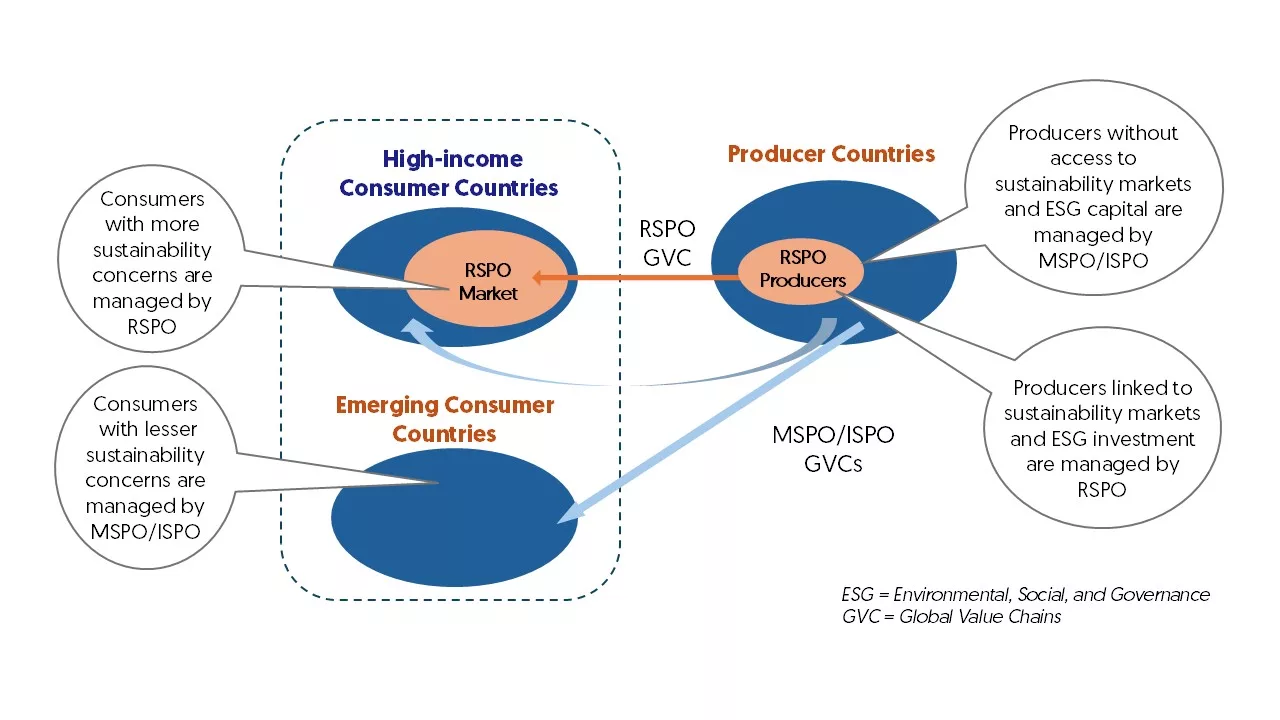
Source: Adapted from UNFSS (2022). Voluntary Sustainability Standards Sustainability Agenda and Developing Countries: Opportunities and Challenges, p.55
Trade and market segmentation
This functional differentiation becomes clearer when global trade patterns are taken into account. High-income countries accounted for roughly 15% of palm oil export destinations from Indonesia and Malaysia in 2023. The remaining share of exports goes to emerging countries, including India and China, which accounted for 21% and 13%, respectively[2]. Although RSPO-certified oil reached approximately 20% of global production in 2023 (RSPO, 2024), procurement of certified oil by major buyers in China and India remains limited, largely due to weak domestic demand.
This market segmentation highlights a structural limitation of sustainability strategies that rely primarily on consumer or investor demand. Where such demand is absent, certification uptake slows—even when environmental risks remain significant. This raises a broader question: how can sustainability be scaled when market incentives alone are insufficient?
The smallholder challenge: scaling sustainability as a global public good
If sustainability in palm oil is framed as protecting forests, biodiversity, and climate stability, then the challenge becomes one of scaling solutions beyond the producers already connected to global markets. A critical point is that around 40% of palm oil is produced by smallholders in Indonesia and Malaysia (BPS Statistics Indonesia 2024, MPOB 2024), and reaching more of them is essential if sustainability is treated as a global public good rather than a niche-market outcome.
However, smallholders face persistent barriers to certification, including costs, limited access to technical knowledge, land legality issues, limited bargaining power, and weak access to support systems. For example, smallholders need to submit cultivation registration documents and identification documents when applying for certification. They also need to provide GPS and polygon data to demonstrate that the land has not been associated with recent deforestation[3].
In response, all three certification standards—RSPO, ISPO, and MSPO—have developed standards tuned for smallholders. The standards allow cooperatives to assist smallholders through group certification and require simplified standard operating procedures and internal management systems. Each standard has expanded assistance and capacity-building programs.
Importantly, ISPO and MSPO are linked to national replanting programs that provide smallholders with subsidies, assistance to sustainable cultivation and can help the smallholders increase yields in the long run. This is crucial because sustainability is not only about stopping deforestation—it is also about ensuring that rural livelihoods are viable and that farmers have pathways to improve productivity without expanding into forests.
A smart-mix approach: when public and private initiatives reinforce each other
Rather than choosing between RSPO and ISPO/MSPO, a more productive framing might be: how can public and private initiatives be combined to expand impact? In some documented cases, support for RSPO certification has also helped independent smallholders strengthen farmer groups, which are important for certification under both RSPO and ISPO as well as for access to some government programs (Musim Mas, 2024). Hence, RSPO processes can help smallholders strengthen documentation and farmer groups, which may support ISPO certification and access to government replanting assistance in Indonesia. In Malaysia, however, MSPO certification alone does not grant access to replanting funds – smallholders must have MPOB registration and meet national program requirements. On the other hand, ISPO/MSPO can serve as a stepping stone toward RSPO certification as the documents collected for ISPO/MSPO can also be used for RSPO certification, and some RSPO requirements are more stringent. In such cases, private incentives (premium markets) and public mechanisms (state support and policy tools) interact to reinforce sustainability outcomes.
This is a smart mix of governance: different standards reaching different segments, while reinforcing each other’s effectiveness. The result can be a scalable impact—especially when the goal is not only to certify export-oriented producers, but to improve practices across the broader landscape.
Conclusion: sustainability needs multiple routes
A key insight from the palm oil sector is that sustainability governance does not operate in a single unified global market. Instead, the market is segmented. Palm oil shows that sustainability is achieved through multiple routes: market incentives, investor pressure, national policies, capacity building, and hybrid interactions across these domains. Private and public standards each have strengths and limitations. The key is to design pathways that expand inclusion and effectiveness. Ultimately, forests and biodiversity are global public goods, and respect for human rights is a universal principle for all people. Protecting them requires solutions that work not only for the most visible corporate actors, but also for the millions of smallholders whose everyday decisions shape land use across Southeast Asia.
What matters, therefore, is not whether public or private standards are superior, but how their complementarity can be used as a smart mix to expand sustainability outcomes at scale.
Businesses and consumers would benefit from taking a holistic view of the certification landscape, while policymakers can explore opportunities to strengthen local standards as a promising area for cooperation.
Footnotes:
[1] In late 2025, Evidensia and UNDP FACS Community held a webinar on “Building bridges in palm oil standards: national meets voluntary”, which brought together representatives from RSPO, ISPO, and MSPO to explore the research findings and share perspectives from their respective standards. Watch the recording here: https://www.evidensia.eco/resources/building-bridges-in-palm-oil-standards-national-meets-voluntary-webinar/
[2] The author used HS1511 for palm oil in the UN Comtrade statistics. In this blog, the high-income countries that import palm oil from Indonesia or Malaysia are Australia, Canada, the EU, Japan, New Zealand, Singapore, Norway, the Republic of Korea, Switzerland, and the US.
[3] For evidence on how supply chain sustainability initiatives impact palm oil smallholders, see the Evidensia library: https://www.evidensia.eco/online-library/?facets%5Blenses%5D%5B%5D=19&facets%5Bproducts%5D%5B%5D=215&sort=recent&order=desc
References:
- BPS Statistics Indonesia. (2024). Oil Palm Statistics 2024. https://www.bps.go.id/id/publication/2024/11/29/d5dcb42ab730df1be4339c34/statistik-kelapa-sawit-indonesia-2023.html
- Malaysian Palm Oil Board. (2024). Oil palm planted area. https://bepi.mpob.gov.my/images/area/2024/Area_summary2024.pdf
- Marx, A., Depoorter, C., Fernandez de Cordoba, S., Verma, R., Araoz, M., Auld, G., Bemelmans, J., Bennett, E. A., Boonaert, E., Brandi, C., Dietz, T., Fouilleux, E., Grabs, J., Gulbrandsen, L. H., Harrison, J., Heilmayr, R., Hernandez, A., Hoekman, B., Lambert, S. R.,…vanderVen, H. (2024). Global governance through voluntary sustainability standards: Developments, trends and challenges. Global Policy, 15(4), 708– https://www.evidensia.eco/resources/global-governance-through-voluntary-sustainability-standards-developments-trends-and-challenges/
- Michida, E. (2023). Effectiveness of self-regulating sustainability standards for the palm oil industry (ERIA Discussion Paper No. 476). Economic Research Institute for ASEAN and East Asia. https://www.evidensia.eco/resources/effectiveness-of-self-regulating-sustainability-standards-for-the-palm-oil-industry/
- Musim Mas. (2024). Enam asosiasi pekebun swadaya binaan Musim Mas berhasil menjual kredit RSPO senilai 20 milyar tahun ini. https://www.musimmas.com/id/sumber-daya/rilis-berita/enam-asosiasi-pekebun-swadaya-binaan-musim-mas-berhasil-menjual-kredit-rspo-senilai-20-milyar-tahun-ini/
- Roundtable on Sustainable Palm Oil. (2024). Impact report 2024. https://rspo.org/resource/impact-report-2024/
- UNFSS (2022). Voluntary Sustainability Standards Sustainability Agenda and Developing Countries: Opportunities and Challenges, p.55. https://unfss.org/wp-content/uploads/2022/10/UNFSS-5th-Report_14Oct2022_rev.pdf
Curious about what the evidence says on ISPO, MSPO, and RSPO?
Explore the Evidensia Library to find credible studies, or use the Geographic Map to see where credible studies have been conducted and identify regional hotspots, the Knowledge Matrix to gain an overview of research across sectors, issues, outcomes, and approaches and spot evidence gaps, and the Visual Summaries to explore the findings of systematic reviews, where individual results from impact evaluation studies are plotted to show clearly what the evidence says on specific research questions.